
Designing electrosurgical, pulsed-field ablation, or diagnostic equipment? Learn how engineers address electrical isolation, leakage current, high-voltage switching, and IEC 60601 compliance challenges with reed relay technology.
If there are particular areas you need help with, feel free to skip to any of the following sections:
Why Electrical Isolation Is Critical for Medical Equipment
Medical technology has changed considerably over the past decades. Surgical procedures that once relied entirely on mechanical instruments now use precisely controlled electrical energy. For example, cardiac treatments can target abnormal heart tissue through carefully delivered electrical pulses, while diagnostic instruments measure signals that provide valuable information about a patient’s condition.
Behind these technologies lies an important engineering challenge. Medical equipment must control electricity accurately while protecting patients, healthcare professionals and the electronics within the device itself.
The requirements vary depending on the application. An electrosurgical generator must deliver sufficient energy to cut or coagulate tissue. A pulsed-field ablation (PFA) system must manage high-voltage pulses delivered through specialised electrodes. A diagnostic instrument may need to measure very small signals without introducing unwanted interference.
Despite their differences, these applications share a common requirement: electrical connections must behave predictably, both when energy is being delivered and when circuits are supposed to remain isolated.
This is where switching technology plays an important role.

Electrical connections must behave predictably, both when energy is being delivered and when circuits are supposed to remain isolated.
Jump to: Why is Isolation Critical | Switching Challenges | The Risks | Key Relay Specifications | Designing for IEC 60601 | Selecting the Right Relay | Custom Relay Solutions | Additional Resources
Switching Challenges in Electrosurgical, PFA, and Diagnostic Systems
Electrosurgery
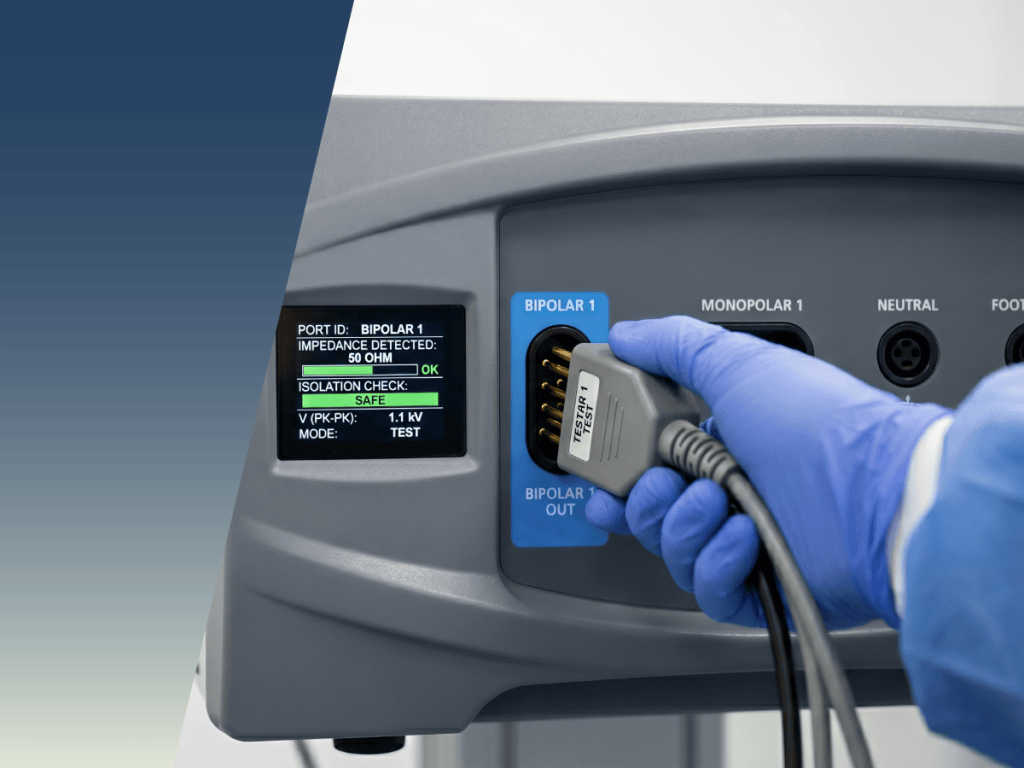
Consider an electrosurgical generator, a familiar piece of equipment in modern operating theatres. Electrosurgery uses high-frequency electrical current to produce localised heating, allowing surgeons to cut tissue or achieve coagulation to control bleeding.
In monopolar electrosurgery, current flows from an active electrode through the patient and returns through a designated return electrode. Bipolar instruments use two closely positioned electrodes, concentrating the current path around the treatment area.
The equipment must control operating modes, select output paths and maintain electrical separation where necessary. Unintended current paths can cause burns, while inappropriate energy delivery can interfere with the intended surgical effect.
Pulsed-Field Ablation (PFA)
Pulsed-field ablation (PFA) addresses a different medical need. Used to treat certain cardiac arrhythmias, PFA delivers short, high-voltage pulses through catheter electrodes to target abnormal heart tissue. Unlike conventional radiofrequency ablation, which relies primarily on heating, PFA uses electroporation to affect cell membranes.
Its electrical architecture must manage electrode connections, pulse delivery and isolation of circuits that should not receive the applied voltage. High instantaneous currents place additional demands on components in the energy path.
Medical Test Equipment
Medical testing equipment presents another perspective. A defibrillator analyser must safely receive and evaluate the electrical output of a defibrillator. Other diagnostic instruments require accurately routed measurement signals and adequate separation between channels, where unwanted leakage or interference can affect measurement accuracy.
The applications differ, but the engineering question remains similar: how do we establish the required electrical connections without compromising the isolation and performance of the system?

Jump to: Why is Isolation Critical | Switching Challenges | The Risks | Key Relay Specifications | Designing for IEC 60601 | Selecting the Right Relay | Custom Relay Solutions | Additional Resources
The Risks of Leakage Current, Arcing, and Inadequate Isolation
Medical systems contain multiple circuits that must be connected or disconnected according to the equipment’s operating state.
- In electrosurgical generators, switches can help select operating modes or configure output paths.
- In cardiac ablation equipment, they may establish connections before a pulse sequence and isolate selected paths afterwards.
- In medical test instruments, switches route signals between measurement circuits.
In all these applications, the switching component must perform reliably in both states.
Closed State
When closed, it must carry the expected current without excessive resistance, heating or signal degradation.
Open State
When open, it must provide sufficient electrical isolation for the voltages present in the system.
Learn how to design with high-voltage reed relays
Reed relays are particularly suitable for applications requiring high isolation. They use an electromagnetic coil to actuate contacts enclosed in a hermetically sealed glass capsule.
This construction provides a reliable electrical path when closed and high insulation resistance when open, whilst maintaining galvanic isolation between the control coil and switched circuit.
As a result, low-voltage control electronics can operate switches handling substantially higher voltages without a direct conductive connection between the circuits.
Comparison of the Key Electrical Requirements for Three Medical Applications
| Medical Application | Electrical Switching Requirements |
|---|---|
| Electrosurgical generators | RF current handling and high-voltage isolation |
| PFA systems | High-voltage withstand and pulsed-current capability |
| Medical test equipment | High insulation resistance and low leakage current |
Jump to: Why is Isolation Critical | Switching Challenges | The Risks | Key Relay Specifications | Designing for IEC 60601 | Selecting the Right Relay | Custom Relay Solutions | Additional Resources
Key Relay Specifications for Medical Device Designers
The performance of a reed relay begins with the reed switch itself.
Two ferromagnetic contact blades are sealed inside a glass envelope containing a controlled gas atmosphere or vacuum. This hermetic construction protects the contacts from contamination, whilst contact materials and surface treatments are selected to meet different electrical load requirements.

At higher voltages, insulation becomes particularly important.
The open contact gap and the separation between the contacts and control coil provide two distinct isolation paths. Their dielectric strength must be considered alongside creepage and clearance distances.
Low leakage current is another important consideration, especially in sensitive diagnostic equipment.
Reed relays offer high insulation resistance, helping minimise unwanted current through open circuits.
Meeting Application-Specific Demands.
These applications also place different demands on relay current handling. High-frequency currents require suitable contact design and thermal performance, while short, high-current pulses demand sufficient pulse-carrying capability. Importantly, a relay capable of carrying a certain current is not necessarily rated to switch that same current under load.
Reliable performance depends on matching the relay’s contact design, insulation and electrical ratings to the specific requirements of the medical application.
Jump to: Why is Isolation Critical | Switching Challenges | The Risks | Key Relay Specifications | Designing for IEC 60601 | Selecting the Right Relay | Custom Relay Solutions | Additional Resources
Designing for IEC 60601 Isolation and Safety Requirements
Electrical safety in medical equipment goes beyond the performance of individual components. IEC 60601-1 sets requirements for the safety and essential performance of medical electrical equipment, including protection against electrical hazards through Means of Operator Protection (MOOP) and Means of Patient Protection (MOPP).
For medical relay designs, this means looking carefully at dielectric strength, insulation, and creepage and clearance distances. The requirements depend on the working voltage, the level of protection needed and possible fault conditions. Some medical devices also need to meet additional safety standards.
High Dielectric Strength / Leakage Current
High dielectric strength is certainly important, but the relay’s voltage rating alone is not enough. How the relay is mounted and connected, as well as the surrounding circuitry, also affects insulation performance. The same applies to leakage current.
High Insulation Resistance
High insulation resistance and low leakage are valuable relay characteristics, but the leakage-current limits of the complete medical device must still be considered.
Taking these requirements into account early in the design helps engineers select the right relay and avoid problems with electrical isolation later in development.
Jump to: Why is Isolation Critical | Switching Challenges | The Risks | Key Relay Specifications | Designing for IEC 60601 | Selecting the Right Relay | Custom Relay Solutions | Additional Resources
Selecting the Right Relay for Your Application
Selecting a relay for medical equipment is rarely a matter of choosing the highest voltage or current rating. An electrosurgical generator may require a balance of RF current capability and insulation, whilst a PFA system may focus on high-voltage isolation and pulse currents. Medical test instruments may place more importance on compact size and low leakage.
Finding the right solution starts with understanding the customer’s application. Standex Detect combines its experience in reed switch engineering, relay design and medical equipment to help customers select or develop suitable switching solutions.

Electrosurgical Equipment Project
Problem
One example comes from an electrosurgical equipment project, where the customer needed a reed relay capable of handling high-frequency currents whilst meeting demanding voltage, isolation and creepage distance requirements.
Solution
Standex worked closely with the customer’s engineering team, developing several customised relay samples for evaluation and testing. This helped the customer identify a solution that met the electrical and safety requirements of their equipment.
Why it Matters
Projects like this show the value of combining the customer’s knowledge of their medical equipment with Standex’s experience in reed relay design. Working together from the early design stages helps find the right switching solution rather than relying on datasheet specifications alone.
Jump to: Why is Isolation Critical | Switching Challenges | The Risks | Key Relay Specifications | Designing for IEC 60601 | Selecting the Right Relay | Custom Relay Solutions | Additional Resources

Custom Reed Relay Solutions for Medical Equipment Designers
Medical applications place different demands on switching components, but they all require reliable performance and appropriate electrical isolation. Choosing the right relay therefore involves more than checking voltage and current ratings on a datasheet. It means understanding how the equipment works and selecting a relay that meets its electrical and safety requirements.
At Standex Detect, we combine our experience in reed relay engineering with an understanding of medical applications to help customers find the right switching solution for their designs.
Developing Medical or Diagnostic Equipment?
Explore our reed relay portfolio or contact our engineering team to discuss your application.
Jump to: Why is Isolation Critical | Switching Challenges | The Risks | Key Relay Specifications | Designing for IEC 60601 | Selecting the Right Relay | Custom Relay Solutions | Additional Resources
Additional Resources
Click on a resource below to download it.
Jump to: Why is Isolation Critical | Switching Challenges | The Risks | Key Relay Specifications | Designing for IEC 60601 | Selecting the Right Relay | Custom Relay Solutions | Additional Resources
Related Articles
-
Medical Device Switching Challenges: Isolation, Leakage Current, and Safety
Designing electrosurgical, pulsed-field ablation, or diagnostic equipment? Learn how engineers address electrical isolation, leakage current, high-voltage switching, and IEC 60601 compliance challenges with reed relay technology.